The exhibition price list is available by clicking on this link below.
When we were children, the future seemed fairly straightforward. We would travel in flying cars, robots would serve us dinner, and technology would finally free us from the dull, exhausting parts of life. Just like in the movies.
And yet we still wait for the tram, go to work, drink coffee, worry, and try to decide what to have for dinner. The robot has arrived, but it seems to be waiting right alongside us.
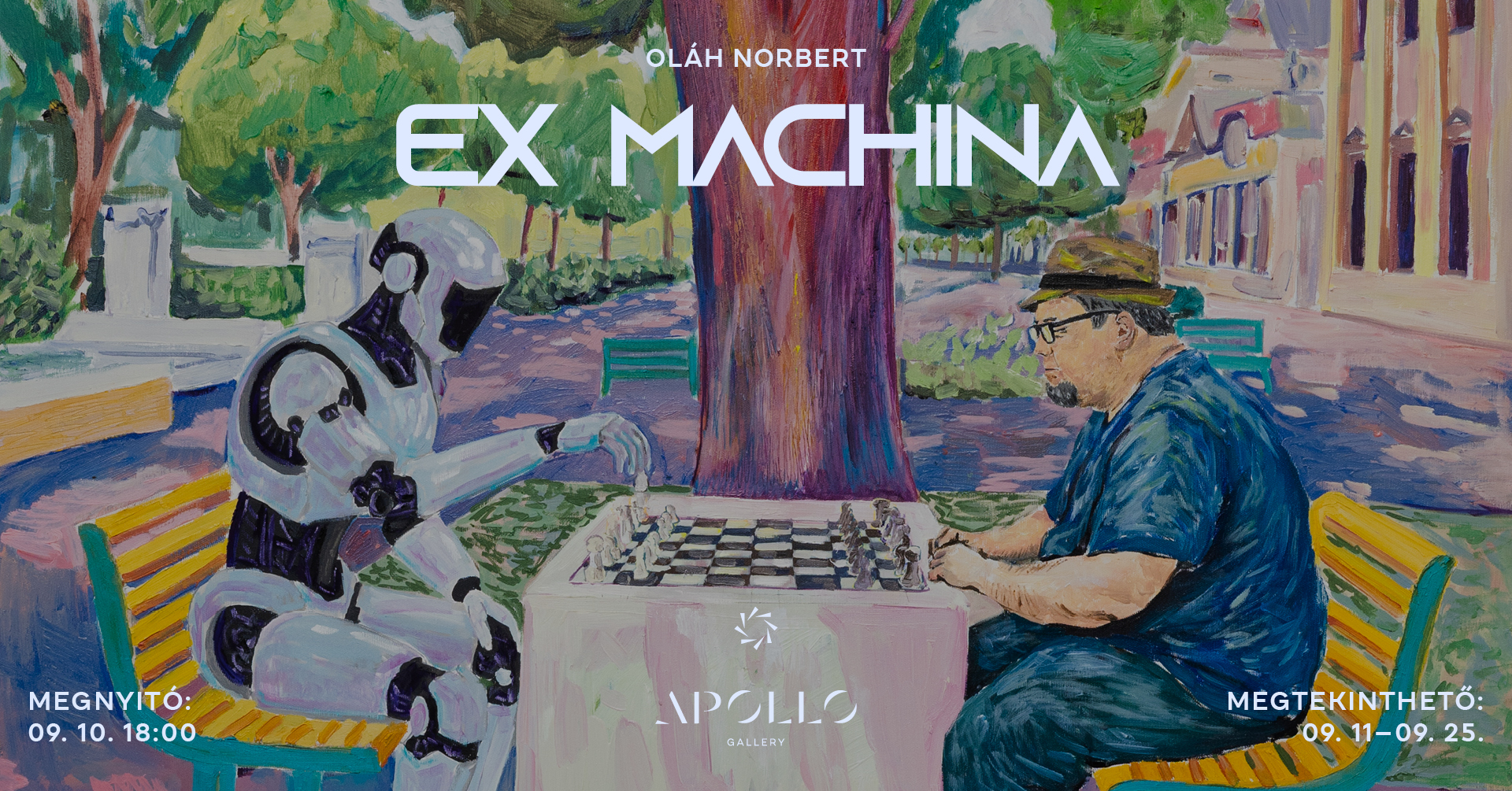
Norbert Oláh’s exhibition Ex Machina takes place in this strangely familiar present. His paintings depict Budapest streets, apartments and urban spaces, populated by well-known figures from the cultural scene and robots whose forms are based on machines that already exist today.
The paintings are everyday genre scenes. Traditionally, genre painting does not focus on the great turning points of history, but observes how we live when seemingly nothing remarkable is happening. In Oláh’s paintings, humans and machines talk, travel, work, play chess, rest or simply exist alongside one another. Yet the naturalness of these scenes soon becomes uncertain. We do not know whether the robots are autonomous AI systems, personal assistants, possessions, friends, or perhaps new bodies for human consciousness. Nor can we quite tell who has adapted to whom.
Perhaps this is why the question of existence becomes so important. Much of human life is rarely spectacular: it consists of repetition, routines, work, waiting, social situations and small decisions. While technology develops at an ever-increasing pace, the fundamental questions of human existence barely change. A robot may appear beside us at work, on the street or at a party, while we continue trying to understand what we are doing here, how we relate to one another, and what exactly makes us think of ourselves as human.
This line of thought is not new to Oláh’s work. Since 2024, his figurative painting has developed into a multi-year sci-fi programme in which optimism and anxiety surrounding technological progress meet social questions, personal stories and irony. His 2024 series Anachronistic Sci-Fi began with portraiture: Oláh placed friends and fellow artists in dystopian-realist, sometimes deliberately anachronistic situations – that is, ones that are outdated or seem to belong to another period. The following year, Gypsies in the Space turned towards questions of Roma representation, social mobility and cultural identity. Space travel became a metaphor for social advancement, while Roma identity appeared as an active part of a global technological future. In Ex Machina, the direction shifts again. We return from a distant or imagined future to everyday life. The future, after all, has arrived without us noticing.
For a long time, science fiction also provided surprisingly precise instructions for how we should live alongside robots. Isaac Asimov’s famous Three Laws established clear rules for this coexistence: a robot may not harm a human being, must obey humans, and may protect its own existence only after these conditions have been met. The later Zeroth Law placed the protection of humanity as a whole above all of these. At first glance, a reassuring system. Isn’t it? The robot knows its place, while the human happens to stand at the top of the hierarchy.
The problem begins when it is no longer clear how long we can regard a robot as merely a tool. Oláh’s paintings take this certainty away from us. His robots do not rebel, they do not want to destroy humanity, nor do they seem particularly interested in saving it. They have simply moved into our everyday lives. After a while, it becomes difficult even to tell who is whose assistant.
The distinctions made by German idealist philosopher Martin Heidegger become particularly interesting in the case of robots. In The Origin of the Work of Art (1950), he distinguishes between the mere thing, equipment made for use, and the work of art, which can disclose an entire world before us. But what happens when a tool talks, waits, plays chess or appears to be bored? Oláh’s robots are machines created to perform certain tasks, yet in the paintings they appear as autonomous characters. We do not know whether they are things or beings, whether they belong to us, or simply live alongside us. The paintings do not resolve this uncertainty. Instead, they make visible the moment when it no longer seems entirely natural to assume that human beings stand at the centre of the world..
The paintings are closely connected to texts by Z. Márió Nemes, which continue, disrupt and rearrange the situations depicted in the images. Together, the visual and textual layers create the world of the exhibition. The paintings do not illustrate the texts, and the texts do not provide an instruction manual for the paintings. Together they create a space in which something difficult to name remains constantly present beneath the humour: a sense of unease.
In this exhibition, science fiction is primarily a method of observing the present. Most stories about the future tend to speak about the age in which they were created. Yet one of the paradoxes of Ex Machina is that there is actually very little science fiction in it. Oláh’s future has already arrived. We may still be waiting for the flying car, but the robot is already here with us. Science and technology are slowly becoming a worldview, at times a kind of technological religion: promising that sooner or later they will answer every question.
The works in Ex Machina are directly connected to the visual language of popular culture. They embrace the spectacle of science fiction, recognisable characters, humour and storytelling. The exhibition does not require a background in philosophy as an entry ticket. That familiar feeling is enough: something very funny is happening, but you are not entirely sure you feel like laughing.
I wrote this text, by the way. At least that’s what the machine claims.