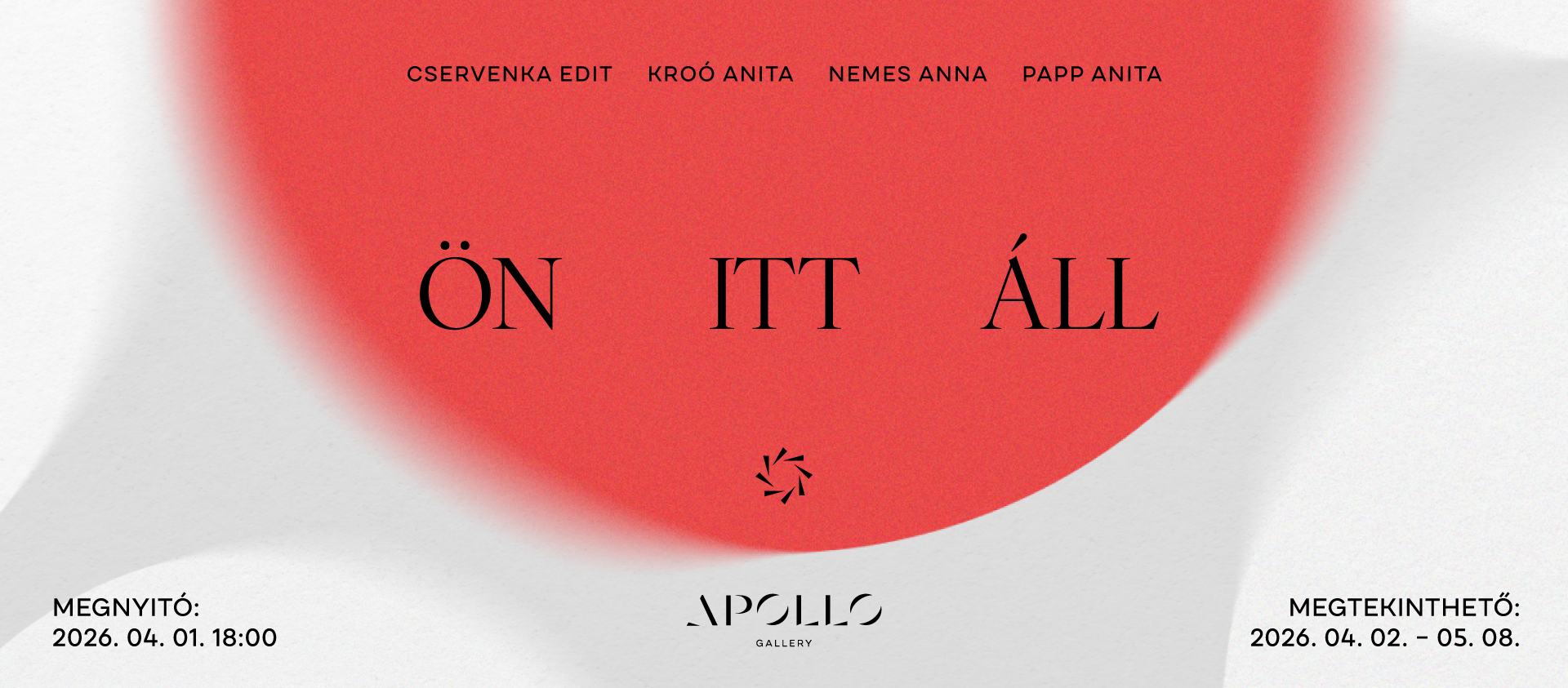
Opening: 2026.04.01. 18:00
The title “You are here” recalls the familiar marker found on maps: the point where viewers locate themselves within a system – and where it becomes evident that the observer is also part of that system.
One of the radical turns of modernity is that human beings no longer only create artworks; they also shape themselves. As Boris Groys has noted, within contemporary culture the subject is not merely a producer of art but a being that continuously becomes aestheticized. We look while being looked at; we shape while being shaped. In this sense, becoming an artwork is not simply a matter of objectification but a network of relations. The body, identity, and social roles do not arise from a closed inner core, but are shaped in relationships. The other’s gaze, expectations, desires, and judgments shape what we call self. Self-image is produced from feedback, reflections, and social contexts. The modern individual is thus a being exhibited in a peculiar way: both observer and observed.
The question is not who we are, but rather what form we take in the eyes of the other.
This dynamic is particularly evident in the case of the female body. The works presented in the exhibition examine how the body becomes an intersection of norms, expectations, taboos, and fantasies. The works of Anna Nemes, Anita Kroó, Anita Papp, and Edit Cservenka approach the female body as a form that is constantly renegotiated and reinterpreted.
The boundary between object and the abject may appear natural at first glance, yet in all cases we speak of cultural construction. What deviates from established norms can easily become an object of disgust or fear. In theoretical terms, the “monster” is the figure that appears at the borders of cultural order, revealing the fragility of the norms that structure it. It is not an inherent quality, but something that emerges whenever familiar forms overflow and question established boundaries.
The Hall 1 exhibition space highlights the mechanisms through the fixation and framing of the gaze. Here, the viewer’s position appears stable. Markings placed on the floor designate specific viewpoints: where one is “supposed” to observe each artwork from. In Hall 2, however, this stability is disrupted. Boundaries become less certain, and the act of looking itself becomes questionable. The transition between the two spaces is therefore not only physical but interpretative. The exhibition establishes its own system of rules while simultaneously questioning the very origins of these rules. Who determines the correct point of view? Who decides what counts as normal and what falls outside the boundaries?
Designated positions offer a sense of security. In exchange for that security, we accept a role. And by accepting the role, we accept the frame.
Becoming an artwork is thus a twofold process. The gaze fixes, frames, and gives form. The one subjected to it internalizes this relation and begins to view themselves from an external perspective. Identity becomes performative – not a given, but a continuously emerging form. The boundary between self-formation and self-surrender begins to blur.
In addition to the possibility of autonomous self-formation, what really matters is who sets the frame.
Who determines what is visible?
What is desirable?
What is repulsive?
What counts as normal?
Visibility is both promise and risk: it can liberate, yet it can also fix and confine. The gaze grants recognition while it appropriates.
This exhibition reveals relations. The works operate as surfaces where body, form, and meaning remain in constant negotiation. The viewer is not left out either: the gaze here is not a passive reception but aformative force. The one who looks is also part of the construction.
Ultimately, the question is not whether we become visible, but at what cost.
Exhibiting artists : Edit Cservenka, Anita Kroó, Anna Nemes, Anita Papp
Curator: Nagy Nikolett Colette
Curator assistant: Hannya Eszter
On view: April 2 – May 8, 2026. During gallery opening hours or by prior appointment.